
How to compute buffer capacity in Python using UliEngineering
You can easily compute the buffer capacity using the UliEngineering Python library:
from UliEngineering.Chemistry.Henderson import buffer_capacity

# Compute buffer capacity for 0.1M acetate buffer at pH 4.76
capacity = buffer_capacity(0.1, 4.76, 4.76)
print(f"Buffer capacity (0.1M, pH=pKa): {capacity:.3f}")

# Compute buffer capacity for 0.1M acetate buffer at pH 4.5
capacity = buffer_capacity(0.1, 4.5, 4.76)
print(f"Buffer capacity (0.1M, pH 4.5): {capacity:.3f}")

# Compute buffer capacity for 0.2M phosphate buffer at pH 7.2
capacity = buffer_capacity(0.2, 7.2, 7.2)
print(f"Buffer capacity (0.2M, pH=pKa): {capacity:.3f}")Example output
Buffer capacity (0.1M, pH=pKa): 0.058
Buffer capacity (0.1M, pH 4.5): 0.057
Buffer capacity (0.2M, pH=pKa): 0.115The buffer capacity calculation determines how effectively a buffer solution resists changes in pH when acid or base is added. This is essential for buffer design, biochemical applications, and maintaining stable pH in chemical processes. Buffer capacity is maximized when the solution pH equals the pKa of the weak acid, and increases with higher total buffer concentration.
The buffer capacity is computed using the formula: $\beta = 2.303 \times C_{total} \times \frac{K_a \times [H^+]}{(K_a + [H^+])^2}$, where $\beta$ is the buffer capacity, $C_{total}$ is the total concentration of the buffer (acid + conjugate base), $K_a$ is the acid dissociation constant, and $[H^+]$ is the hydrogen ion concentration. Higher values indicate greater resistance to pH changes.
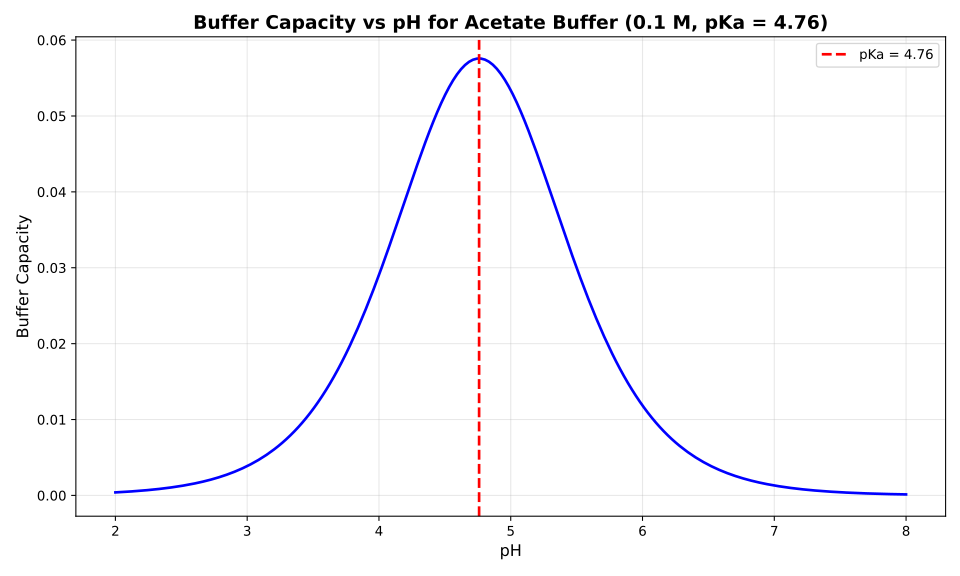
The plot above shows the buffer capacity versus pH for a 0.1 M acetate buffer with pKa = 4.76. Notice the characteristic bell-shaped curve that peaks at pH = pKa, where the buffer capacity is maximum. This demonstrates why buffers are most effective when the pH is close to the pKa of the weak acid.
Related posts
- How to compute Henderson-Hasselbalch pH in Python using UliEngineering
- How to compute Henderson-Hasselbalch pKa in Python using UliEngineering
- How to compute molarity from moles and volume in Python using UliEngineering
Plot generation script
#!/usr/bin/env python3
import matplotlib.pyplot as plt
import numpy as np
import sys
sys.path.insert(0, '/home/uli/dev/UliEngineering')

from UliEngineering.Chemistry.Henderson import buffer_capacity

# pH range for plotting
pH = np.linspace(2, 8, 200)  # pH 2 to 8

# Create plot
plt.figure(figsize=(10, 6))

# Calculate buffer capacity for acetate buffer (pKa = 4.76, C_total = 0.1 M)
pKa = 4.76
C_total = 0.1

# Calculate Ka from pKa
Ka = 10 ** (-pKa)

# Calculate H+ concentration from pH
H = 10 ** (-pH)

# Calculate buffer capacity
beta = 2.303 * C_total * (Ka * H) / (Ka + H) ** 2

plt.plot(pH, beta, color='blue', linewidth=2)
plt.xlabel('pH', fontsize=12)
plt.ylabel('Buffer Capacity', fontsize=12)
plt.title('Buffer Capacity vs pH for Acetate Buffer (0.1 M, pKa = 4.76)', fontsize=14, fontweight='bold')
plt.grid(True, alpha=0.3)

# Mark pKa
plt.axvline(x=pKa, color='red', linestyle='--', linewidth=2, label=f'pKa = {pKa}')
plt.legend(loc='upper right', fontsize=10)

plt.tight_layout()
plt.savefig('buffer_capacity_plot.svg', format='svg', dpi=300)